
The renewal arrived like any other piece of mail. But the number on the first page stopped you cold. Twenty-two percent more than last year. No claims. No changes to the property. Just a number — and a quiet message from your carrier: the risk of owning a home on the South Carolina coast has been repriced, and you're the one absorbing it.
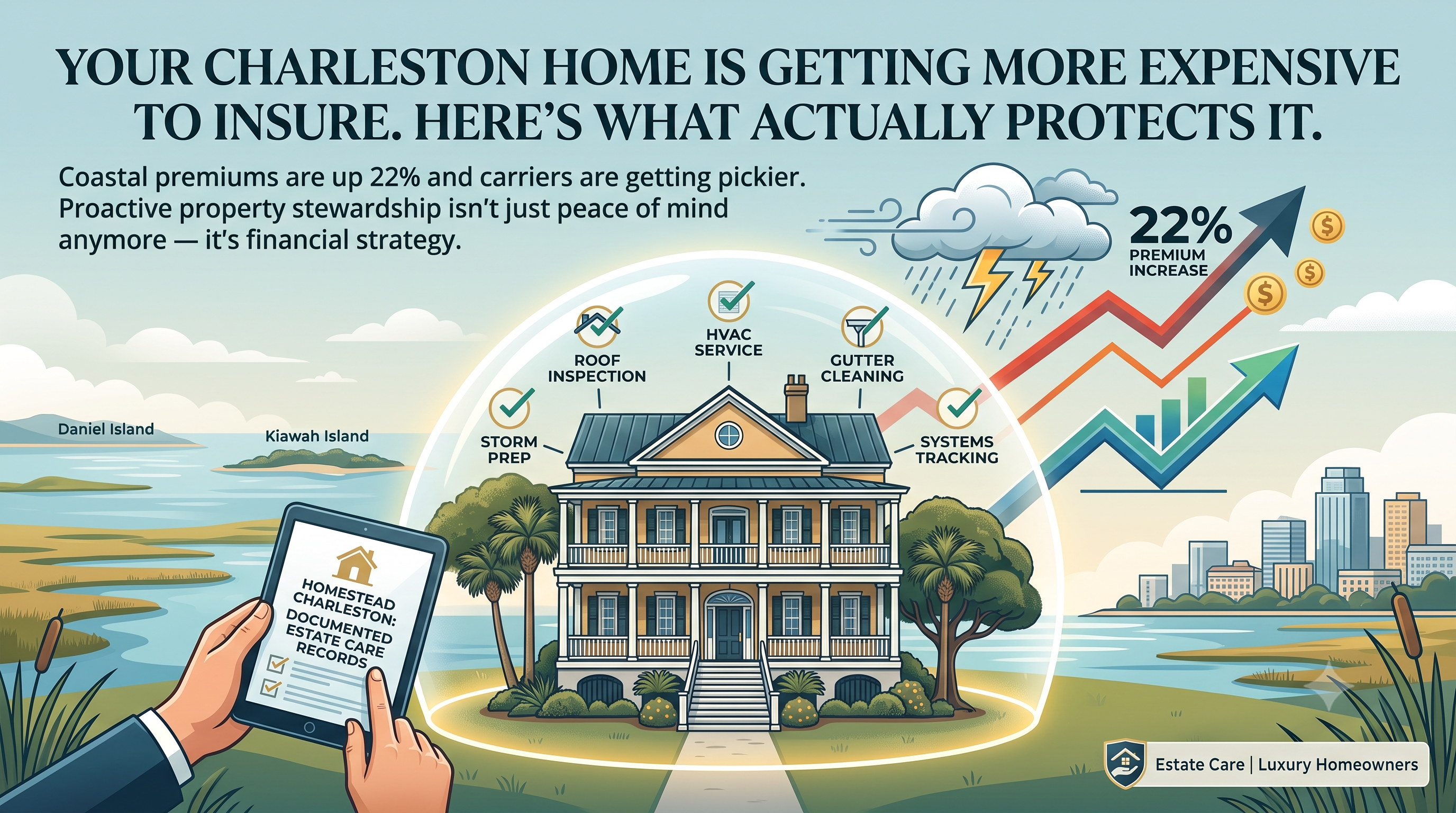
Charleston-area homeowners saw average insurance premium increases of roughly 22% heading into 2026. On coastal properties — Daniel Island, Mount Pleasant, Kiawah Island — the exposure is layered: hurricane, wind, flood, and hail. Average annual premiums in Charleston are now approaching $5,720 per year, and that's before separate wind riders and flood policies are factored in. Nationally, more than 80% of homeowners expect premiums to rise again this year. One in three says they're not confident they'll be able to maintain adequate coverage at all.
The instinct for most homeowners is to shop carriers and hunt for a better rate. That's reasonable. But the more durable play — the one that protects your home's value and your ability to stay insured — is something different. It's about what you can actually control.
What Carriers Are Actually Looking For
Insurance underwriters have gotten more selective, not just more expensive. When a carrier sends an inspector to your property — or pulls satellite imagery, as many now do before renewal — they're making a decision about risk. A roof showing early soft-spot wear. A crawlspace with standing moisture. Gutters impacted with debris heading into hurricane season. An HVAC system running years past its service interval. These are not cosmetic concerns. They are flags that move you from preferred client to marginal risk.
In a market where carriers have been quietly reducing new-business writing in coastal South Carolina, being flagged matters. The homeowners seeing the sharpest premium increases — or losing their policies outright — are often not the ones with major claims history. They are the ones whose properties slid into deferred maintenance while life happened: demanding careers, travel, family, the general fullness of a busy year. A missed seasonal inspection. A vendor appointment rescheduled and never rescheduled again.
The financial math on deferred maintenance runs against you in both directions. Industry benchmarks show that reactive repairs cost 30–50% more than scheduled maintenance completed on time, and deferred costs compound at roughly 7% per year. A $400 gutter cleaning skipped this fall becomes a $1,200 fascia replacement before spring. The roof inspection that didn't happen becomes an insurance carrier's reason to re-underwrite your entire policy.
*"The properties that stay well-insured and well-valued share a common trait: someone is paying consistent, professional attention to them. Not reactive attention. Proactive attention — with documentation to prove it."*
The Real Cost of Coordinating It Yourself
Most homeowners with quality properties in the Lowcountry are not short on motivation to care for their homes. What they're short on is bandwidth. The vendor roster for a serious home is extensive: HVAC service, pest control, plumber on call, landscaping, irrigation, pool care, annual roof inspection, generator testing, gutter maintenance, storm shutter checks before a named storm. Each one involves a separate relationship, a separate schedule, separate invoices, and the ongoing weight of following up when something isn't done right.
When you're managing a full professional life — a demanding career, regular travel, family obligations — the coordination overhead becomes the hidden cost of homeownership. Not the cost you budgeted for. The cost that leaks out sideways, in hours you didn't plan to spend and problems that surface at the worst possible moment.
And it's not just time. It's trust. Finding a vendor you can genuinely rely on in Charleston's tight labor market is difficult. Getting that vendor to show up consistently, document their work, and be accountable to someone other than their own schedule requires active management that most homeowners never signed up for.
A Different Standard for Homeownership
Homestead Charleston was built for the homeowner who wants their property managed the way a fiduciary manages an investment — with professional accountability, documented maintenance records, and zero conflicts of interest baked into the structure.
The model is straightforward: a flat-fee estate care retainer, no vendor markups, no commissions buried in service invoices. Homestead Charleston's aligned interest is with your home, not with any vendor relationship. Every contractor is vetted. Every visit is documented. Every service interval is tracked. When your insurer asks for evidence of consistent maintenance — as many are now beginning to require — that documentation exists and is organized.
This is not a home watch service. It is not someone checking for broken windows while you travel. Estate care is year-round property stewardship: coordinating seasonal maintenance, managing vendor relationships, tracking your home's condition across systems, and being the licensed professional on the ground so you don't have to be. Whether you're home every week or travel frequently, the property is managed to the same standard.
Homestead Charleston works with homeowners on Daniel Island, Mount Pleasant, Kiawah Island, and the Charleston peninsula — people with full lives and high standards for their homes, who want the confidence that comes from knowing the property is genuinely cared for.
Insurance Is the Symptom. Property Condition Is the Answer.
The premium increases will likely continue. South Carolina's coastal exposure is real, and the reinsurance market has priced it accordingly. But there is a meaningful difference between the homeowners who are fighting their carriers every renewal cycle and the ones who aren't.
The difference is rarely the location. It's the condition. And condition — the kind that protects your coverage, preserves your equity, and keeps a complex property running the way it should — is a product of sustained, professional attention to the details that matter.
You chose this property because it deserves to be owned well.
Own it. Enjoy it. Leave the rest to us.