

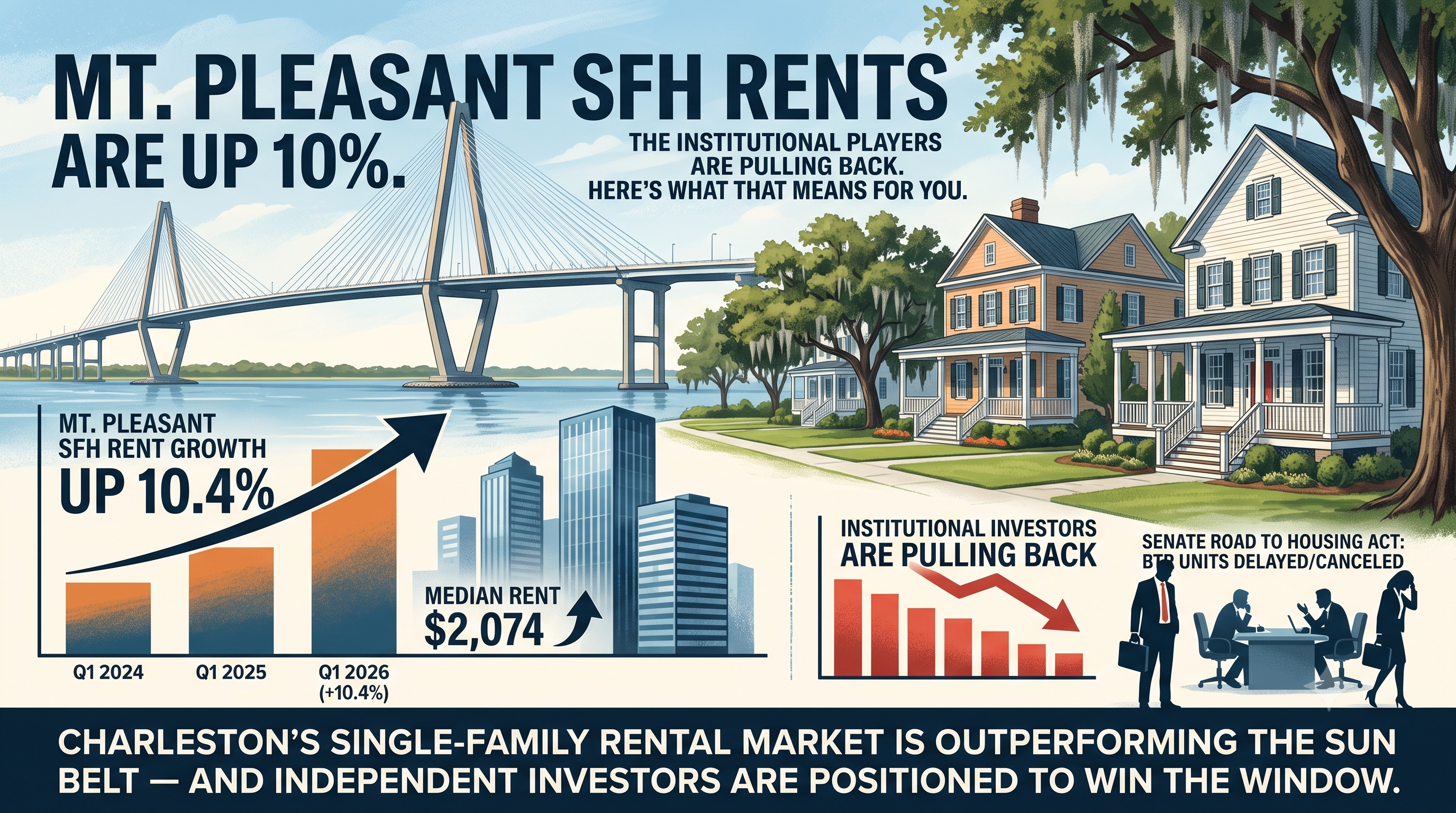
The same week Congress advanced legislation designed to push institutional investors out of the single-family rental market, Mt. Pleasant posted SFH rent growth of 10.4% year over year. Summerville came in at 8.9%. The Charleston metro median rent hit $2,074 in May 2026, with homes leasing in an average of 14 days.
While Austin fell 4.2% and Jacksonville slid 1.9% — while Sun Belt markets that built too fast stared down a multi-year absorption grind — Charleston's single-family rental sector quietly kept doing what it does: holding firm.
If you own a single-family rental in this market, this is the environment you've been building toward. The real question is whether you're actually capturing it.
The Institutional Pullback Is Real — and It Changes Your Position
On June 12, GlobeSt reported that approximately 6,000 single-family build-to-rent and fix-to-rent units have already been delayed or canceled as institutional investors pause acquisitions to assess the Senate's ROAD to Housing Act. The legislation — passed 89-10 in March — targets institutional landlords controlling 350 or more homes. It doesn't touch independent investors. But the market effect is real.
Institutional capital is stepping back. The well-funded operators with dedicated leasing teams, analytics departments, and investor-grade maintenance infrastructure are slowing acquisitions. That means fewer competitors at the purchase table, tighter supply of professionally managed rental inventory, and — if you're running your portfolio with actual rigor — a quality advantage that becomes visible exactly when the market starts separating operators from owners.
The institutional players didn't win their market share by accident. They won it with systems, data, and professional execution. Now that they're retrenching, those advantages are available to independent investors who run their properties the same way.
*In a market where the large operators are distracted by legislation and borrowing costs, the boutique investor who actually answers the phone and fixes the HVAC on time becomes the landlord every tenant wants to stay with.*
What This Market Rewards Right Now
GlobeSt's January analysis put it plainly: "Resilient demand alone no longer guarantees easy leasing." The operators who outperformed in 2025 and into 2026 competed on execution — pricing precision, faster response times, sharper tenant relations. Macro tailwinds are not a substitute for operations.
Charleston's concession rate hit 64% in Q1 2026, with two in three active listings offering move-in incentives. That number is telling. It means the inventory in this market is not uniform. Properties are leasing in 14 days — and properties are sitting. The difference usually isn't the zip code. It's how the property is run.
Every 30-day vacancy at the Charleston metro median costs you $2,074. Every lease renewal you retain costs you $0 in turnover. The math on tenant retention is not complicated, but executing on it requires attention, responsiveness, and a management system that isn't held together by text messages and calendar reminders.
This is the moment when property management transitions from a line item to a competitive advantage. Self-managing three properties across Charleston and Mt. Pleasant means carrying a part-time job you didn't apply for — pricing on intuition instead of market data, handling maintenance calls on weekends, offering concessions to fill vacancies that better tenant retention might have prevented.
Why Charleston's SFR Numbers Hold Up — And Why That Won't Last Forever
Charleston is not an overbuilt Sun Belt market. It's a metro with constrained geography — barrier islands, wetland regulations, historic preservation districts — that limits what gets built where, and ensures that quality single-family inventory stays scarce. Rising home prices aren't pulling renters out of the market. They're keeping creditworthy, qualified households in long-term tenancies — exactly the tenant profile that makes SFR ownership in this market a durable income play.
The multifamily sector has seen modest rent softness (-0.6% to -1.5% year over year) driven by new apartment deliveries. Single-family homes are a different conversation. The landlord leaving an apartment for a house in Mt. Pleasant is not coming back. The professional household priced out of homeownership by a 7% mortgage rate is signing a lease and staying put. That structural dynamic doesn't change because a few hundred BTR units got delayed.
What does change is who's best positioned to serve that tenant and keep them. At a flat 15% of rent collected — no vendor markups, no maintenance kickbacks, no hidden fees — Homestead Charleston manages boutique SFR portfolios for investors who want to compete seriously in this market without building an operations department to do it. We know the contractors. We know the neighborhoods. We know what a well-priced, well-maintained property in Daniel Island's rental submarket looks like, and we know what it takes to keep it occupied.
The Charleston SFR market is performing. The institutional competition is pulling back. The tenant demand is durable.
The window is open. How you operate inside it determines what you take home.
The rental income. Not the landlord life.