
The letter arrived quietly. Not a cancellation — something almost worse: a non-renewal notice. Your insurer, the one that's covered your home on Daniel Island for the better part of a decade, has decided to "reduce coastal exposure." They're moving inland. Your property isn't.
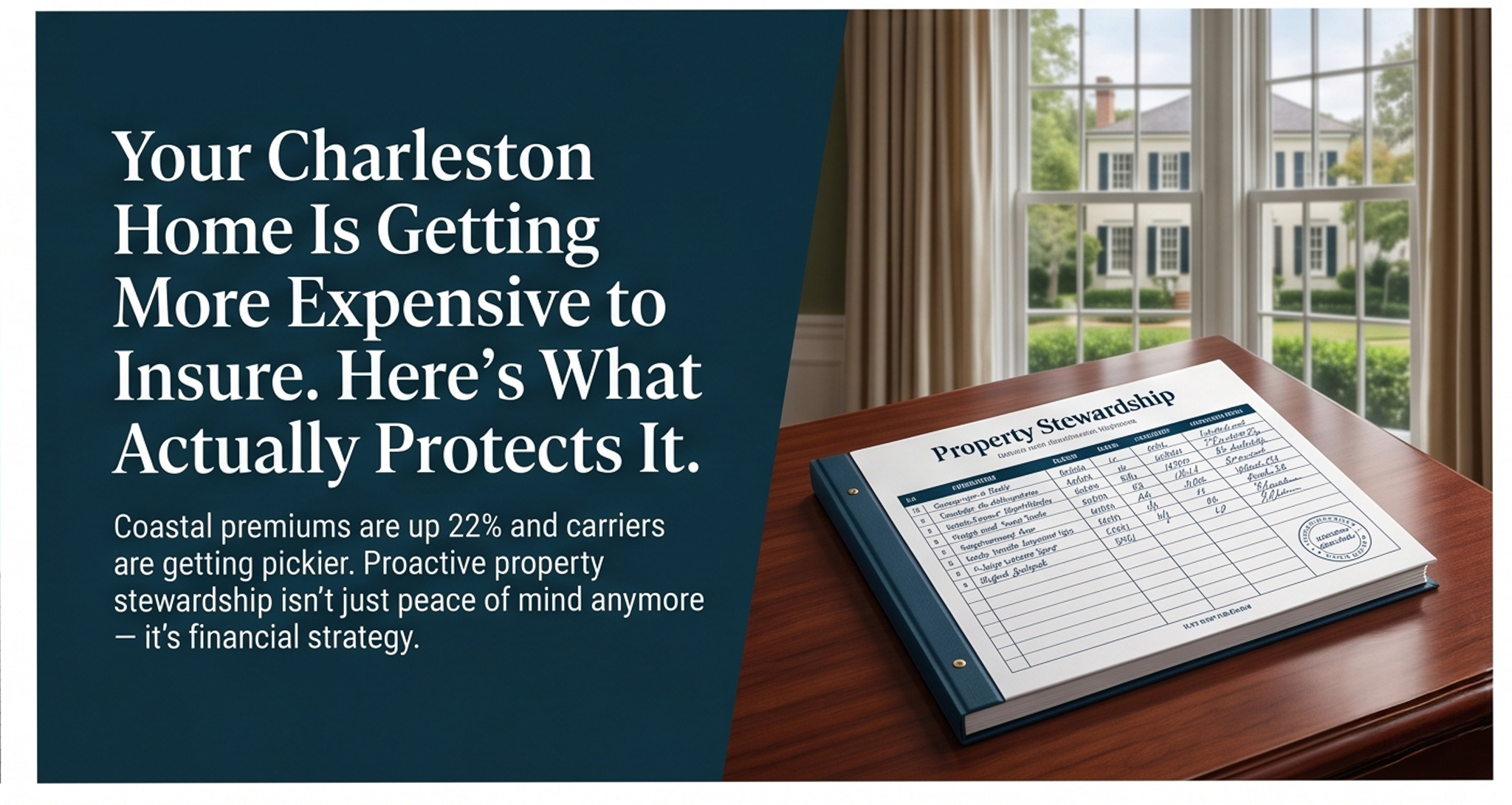
If this hasn't happened to you yet, you've likely heard it from a neighbor. South Carolina homeowners saw insurance premiums climb roughly 22% heading into 2026. Some carriers aren't just raising rates — they're exiting the market entirely. "Some carriers are non-renewing due to reinsurance issues," Michael Dew of the Taylor Agency on Daniel Island told The Daniel Island News. "Some are non-renewing as they want to move further back from the coast. Some are stopping new sales altogether."
This is the quiet anxiety running through Charleston's neighborhoods right now. Not a storm — not yet. Just the slow, creeping realization that the safety net you've been paying for is getting harder to keep, harder to understand, and dramatically harder to afford.
**Why Your Home's Story Matters More Than Ever**
Insurers aren't retreating from the Lowcountry because of a single bad year. They're recalibrating against a decade of hurricanes, flooding, tropical storms, and the lingering financial aftermath of every season since Dorian. In South Carolina, the combined ratio for homeowners' insurance hit nearly 144% at the end of 2024 — meaning for every dollar collected in premiums, carriers paid out $1.44 in claims. That math is not sustainable, and carriers are responding accordingly.
What this means for homeowners is subtle but significant. The coverage you've been carrying may not be the coverage you think you have. Deductibles are climbing. Windstorm riders are being restructured. Some policies now exclude specific storm categories or require separate flood coverage that owners have never had to carry before. And if your home has deferred maintenance — an aging roof, an outdated electrical panel, HVAC systems past their useful life — you may find your renewability, not just your rate, is now in question.
Before June's hurricane season peaks, insurers are making underwriting decisions based on what they can see. A home with a documented service history looks different than one without. A roof with a recent inspection carries differently than one that hasn't been touched since 2019. These distinctions now carry real financial weight.
*The home that gets inspected, documented, and cared for is the home that stays insurable. The one that doesn't is the one that costs twice as much to protect — or can't be protected at all.*
**The Maintenance Gap Nobody Talks About**
There's a pattern that repeats itself every hurricane season in this market. A homeowner — busy, accomplished, fully capable of managing a complex life — discovers that something went wrong at their property. A small roof leak became a mold issue. An ignored HVAC filter became a system replacement. A skipped inspection meant the insurance adjuster found something the owner didn't know was there.
None of these are catastrophes in isolation. But each one is evidence of the same underlying problem: the home didn't have someone paying close attention.
This isn't a criticism. It's the natural consequence of owning a quality home in the Lowcountry while also running a career, raising a family, and not being on Daniel Island every single day. Homes at this level — on Mt. Pleasant, Kiawah, the peninsula — require ongoing, proactive attention. The kind that catches the slow leak before it becomes the ceiling repair. That schedules the annual roof inspection before the carrier requires it. That documents the HVAC service history so the underwriter sees a well-maintained asset, not a question mark.
Deferred maintenance doesn't just increase repair costs. It changes your insurance story. And in 2026, your insurance story matters more than it has in years.
**What Proactive Property Management Actually Does**
Homestead Charleston operates on a model most property management companies in this market don't: flat fee, fiduciary alignment, zero vendor markups. Our job is to protect your property and your peace of mind — not to steer repairs toward contractors who pay referral fees.
For estate care clients, that means a structured, documented approach to your home throughout the year. Seasonal walkthroughs before and after storm season. A standing relationship with vetted vendors across every trade — people who know your property, not strangers dispatched on a work order. Maintenance scheduled proactively so it happens on your terms, not in response to an emergency that costs three times as much to fix after the fact.
When your roof is inspected annually and documented, when your systems are serviced on schedule, when every repair has a paper trail — your home tells a different story to an insurance carrier than one that doesn't. In a market where carriers are actively looking for reasons to reduce coastal exposure, that story is worth protecting. It is, in a very real sense, part of what your home is worth.
This isn't about adding something to your plate. It's about making sure someone who knows your home is watching it with the same care you would — before the carrier sends a letter you didn't see coming.
**Own It. Enjoy It.**
You didn't buy a home on Daniel Island to manage a to-do list. You bought it because the Lowcountry has a particular way of making a long week feel like it never happened, and because a well-built home in this market is one of the better things you can own.
The goal of estate care is simple: remove what shouldn't have been there in the first place. The nagging worry about what's happening to your property when you're not there. The annual insurance conversation you dread. The sense that something is always slipping slightly out of control.
You own it. You should enjoy it. Own it. Enjoy it. Leave the rest to us.