
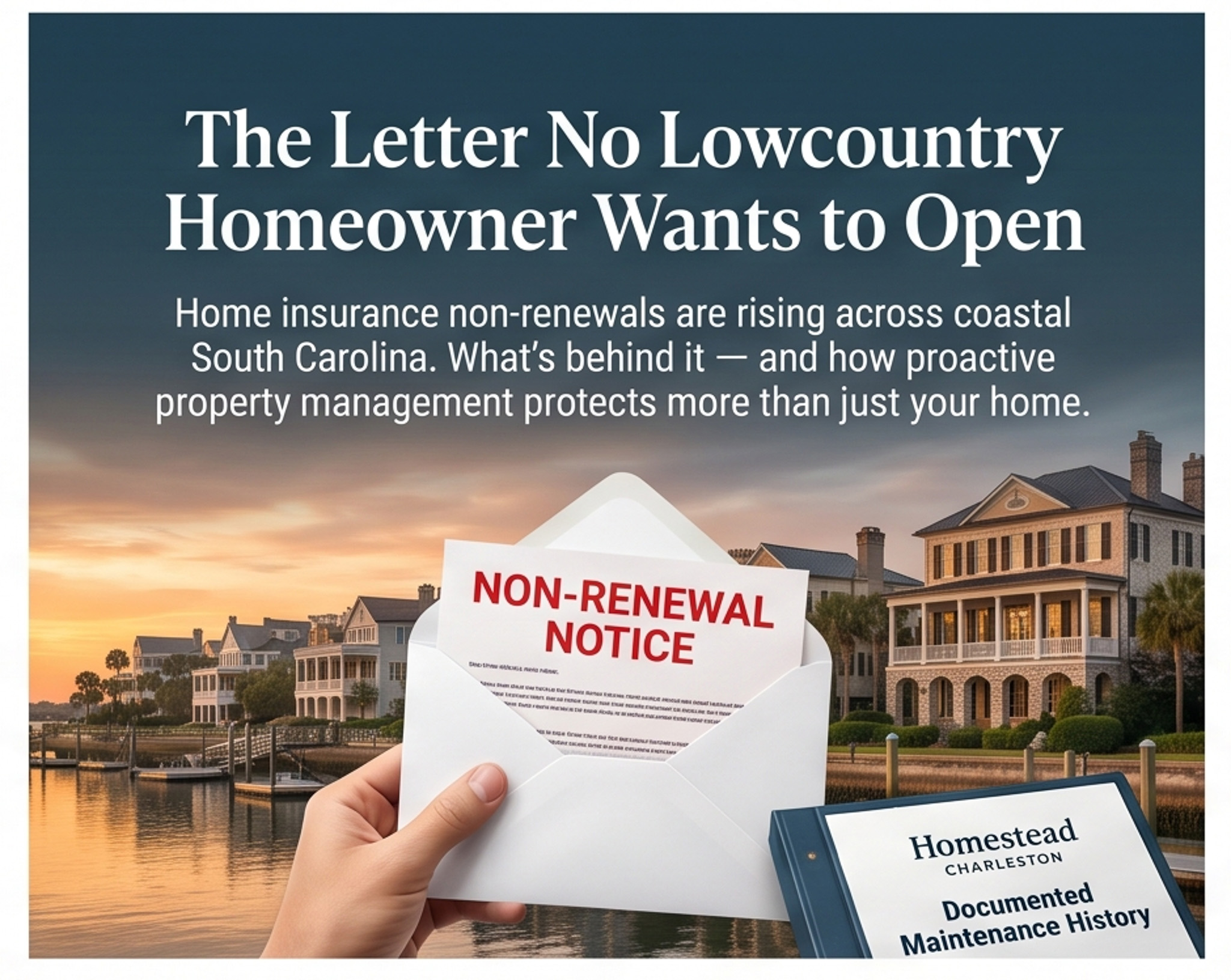
The envelope doesn't look different from the others. But somewhere between the HOA newsletter and the quarterly investment statement, it's there — a letter from your insurance carrier informing you that, effective sixty days from now, your homeowner's policy will not be renewed. You haven't filed a claim in a decade. Your home is beautifully maintained. You've paid every premium on time. And still.
This scenario is not hypothetical. It has landed in mailboxes across Daniel Island, Kiawah, the Charleston peninsula, and the barrier islands with increasing frequency over the past year. A May 2026 CNBC survey found that 42% of homeowners say their insurance costs have risen "a lot" — and nearly one in three say they're no longer confident they can maintain adequate coverage through the year. In coastal South Carolina, the situation is more acute. Carriers are repricing risk, restricting new policies, and quietly exiting markets where their exposure to severe weather has outpaced what they're willing to absorb. Homeowners who have been with the same carrier for fifteen years — without a single claim — are receiving non-renewal notices.
**Why This Is Happening Now**
The reasons trace back to structural shifts in the insurance industry, not bad luck on any individual homeowner's part. Reinsurance costs — what insurance companies pay to insure their own exposure — have risen dramatically in the wake of back-to-back catastrophic storm seasons. Carriers that historically covered coastal South Carolina have tightened underwriting standards, reduced capacity, or exited the market entirely. South Carolina law requires only 60 days' written notice and a stated reason for non-renewal, giving carriers a legal path to a quick exit.
What this means in practice: your insurability is no longer a passive condition. It is something that can be protected — or eroded — by how your home is managed.
Carriers increasingly scrutinize property condition during underwriting and at renewal. Homes with documented, proactive maintenance histories are insurable at competitive rates. Homes with deferred maintenance, thin documentation, or unresolved issues — regardless of how nice they look from the street — are the ones carriers are declining.
Nationally, insurance now accounts for 9% of the typical homeowner's monthly housing cost, the highest share ever recorded. Premiums are up 24% since 2021 and are projected to continue rising through the year. In a coastal state already contending with hurricane exposure, wind and hail risk, and rising reinsurance costs, the Lowcountry faces that national trend at an amplified level.
*"The homes that stay insurable in this market aren't just the ones that look good. They're the ones that can prove it — with records, with maintenance logs, with a documented history of care."*
**The Documentation Gap Most Homeowners Don't See Coming**
Most homeowners maintain their properties on feel rather than record. The HVAC gets serviced when it starts making noise. The roof inspection happens after a storm event, not on a schedule. The crawl space moisture barrier gets attention when there's a concern, not because someone is watching it proactively. This informal system works — until a carrier's underwriter asks for evidence.
The shift in insurance markets means that documentation now has real dollar value. A water intrusion claim on a roof with a three-year inspection gap is handled differently than one with a current inspection record and a maintenance history. A non-renewal notice issued for "unacceptable risk profile" often translates, in practice, to this: your home doesn't have the paper trail we need to underwrite it confidently.
Busy homeowners — executives, military officers, federal employees, professionals navigating full lives alongside significant properties — are the most vulnerable to this gap. Not because they don't care about their homes. Because they have other things to do. Documentation doesn't happen automatically. It requires someone who is paying attention, on a schedule, with every visit logged and every vendor invoice on file.
The challenge isn't maintenance itself. Most Lowcountry homeowners are diligent in their intent. The challenge is that intent and documentation are not the same thing — and in today's insurance market, only one of them counts.
**What Estate Care Actually Provides**
Homestead Charleston's estate care model was built for this kind of ownership. The premise is simple: your home is your most significant asset. It should be managed with the same discipline you'd apply to any asset of that value — not because you're a real estate investor, but because the stakes are high, the costs of neglect compound, and you shouldn't have to manage it yourself.
The model is fiduciary. There are no vendor markups — the invoice you see is the invoice Homestead Charleston pays. There are no referral fees, no kickbacks, no financial incentive to recommend one contractor over another. The fee is flat. The vendors are vetted. And everything is documented: every inspection, every service call, every repair, organized and accessible.
When an insurance carrier asks for evidence of how a home has been cared for, the answer isn't a vague recollection. It's a file.
This isn't a service for people who aren't paying attention to their homes. It's for people who are paying attention to everything else in their lives and want their home handled with the same care and accountability they'd expect from any trusted advisor.
On Daniel Island, in Mount Pleasant, along the Kiawah corridor and the Charleston peninsula, Lowcountry homeowners are navigating one of the most volatile insurance environments in a generation. The ones best positioned are not the ones hoping their carrier doesn't look too closely. They're the ones who've made sure there's nothing to hide — and everything to show.
Own it. Enjoy it. Leave the rest to us.