

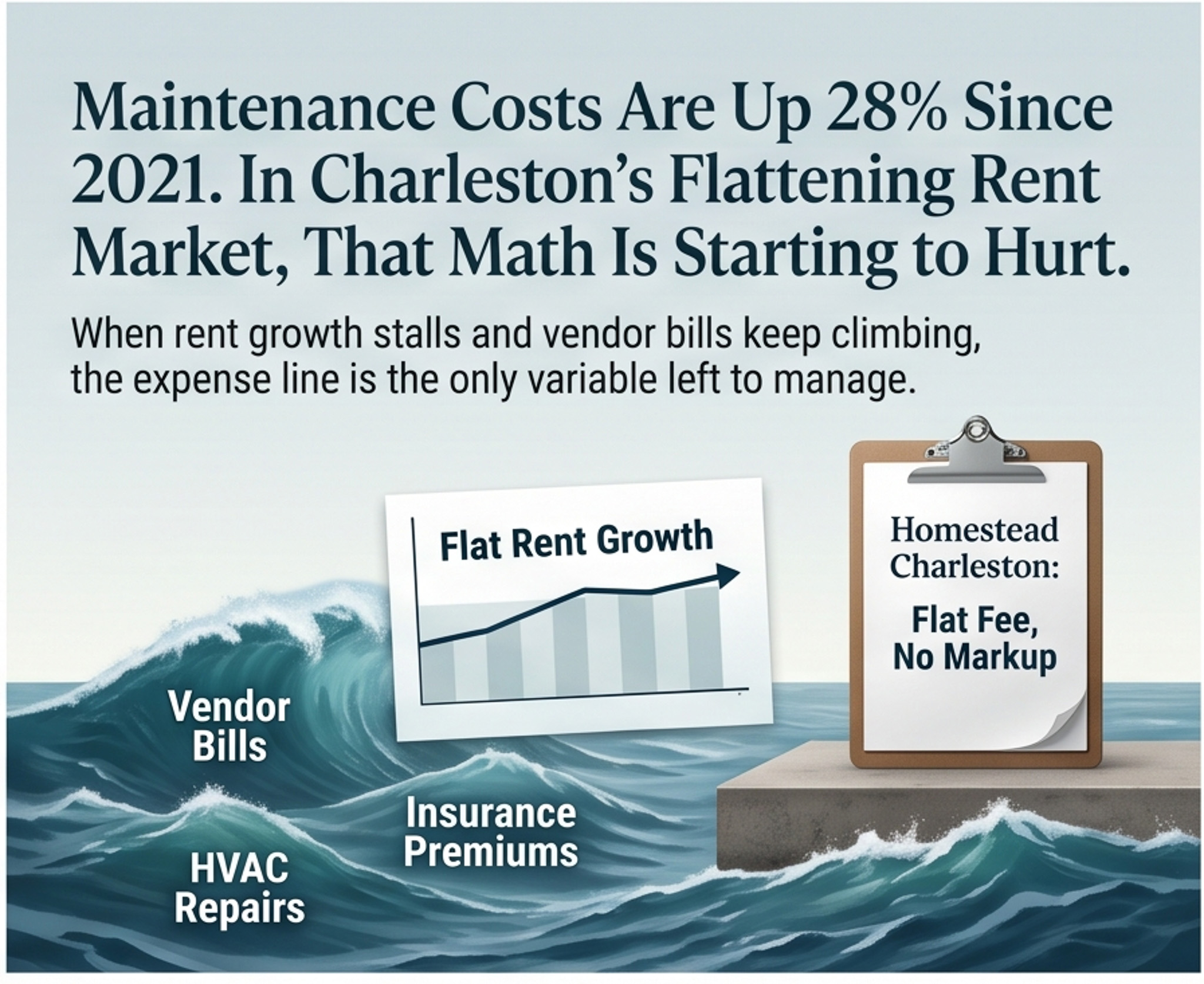
Here's the number most Charleston rental investors are avoiding: median rent across the metro hit $2,074 in May 2026 — down 2% year over year. For single-family homes specifically, the picture holds better; the SFR median came in at $2,838, and demand remains real, with properties leasing in an average of 14 days across the market. But the days of 8% annual rent growth are behind us. The Charleston market has matured into a more competitive, data-driven phase — and what that means for your returns depends almost entirely on what's happening on the other side of your P&L.
Here's that number: repairs and maintenance costs have risen more than 28% since 2021. Skilled labor — plumbers, HVAC technicians, electricians — is in short supply and commanding premium rates in a tight trades market. Construction materials remain 30% above pre-pandemic baselines. Landlord insurance premiums have risen 119% over four years. The gap between what you're collecting in rent and what you're spending to maintain the asset is narrower than it's been since you bought the property.
For most of the past decade, SFR investors in the Charleston market absorbed rising costs without much pain because appreciation and rent growth covered the spread. That cushion has thinned. In a maturing market, returns are no longer a function of market timing alone — they're a function of operational discipline.
**The Vendor Problem That Compounds Quietly**
Most self-managing landlords operate through an informal network: an HVAC company that's been reliable, a handyman they trust, a plumber discovered after a bad experience with someone else. This is how it gets done. And for a long time, it worked.
The problem is that in today's labor market, those relationships are under real strain. Trusted vendors are busier than they've ever been. Response times are longer. Bids are coming in higher. When a maintenance request sits open for two weeks because the go-to contractor is backed up, the cost isn't just the repair — it's the tenant friction, the lease renewal risk, and the deferred damage that compounds quietly in the meantime.
Industry data puts the premium on reactive maintenance at 10 to 30% above proactive management spend. Standard guidance is to reserve 8–12% of annual rent for repairs. At $2,838 per month for a single-family home in the Charleston market, that's roughly $2,730 to $4,100 per year — per property. Fragmented vendor relationships, reactive dispatching, and deferred work orders push that number higher, silently, year after year. And when you're self-managing across more than one property, the coordination overhead compounds faster than most investors account for.
*"In a market where rents are flat, the variable you actually control is your expense line. That's where management quality shows up — or quietly doesn't."*
**What the Charleston Market Is Actually Telling You**
The fundamentals in East Cooper and the surrounding submarkets remain solid. The multifamily oversupply that has hammered Sun Belt metros — negative rent growth in Austin, Atlanta, and Tampa — hasn't hit Charleston's single-family segment in the same way. Vacancy isn't the crisis it is elsewhere. Qualified tenants are still showing up. Daniel Island and Mount Pleasant continue to attract the kind of renter profile — dual-income households, military families, young professionals — that pays on time and stays for multiple lease cycles.
But what's changed is the margin for error. When the Charleston market was appreciating at double digits and lease renewals routinely came with 10–15% rent bumps, a self-managing landlord could absorb inefficiency and still come out ahead. Leaving money on the table — on vendor pricing, on maintenance timing, on lease renewal strategy — was a manageable cost. Today, that same inefficiency has a bigger impact on a tighter margin.
The investors feeling squeezed right now aren't necessarily doing anything wrong. The market changed around them. Managing a property in Mount Pleasant in 2021 felt sustainable because the returns were generous enough to absorb the overhead. In 2026, that generosity has narrowed. The question isn't whether your property is performing — it's whether your operating costs are being managed with the same rigor as your acquisition decisions.
**What 15% Actually Buys You**
No vendor kickbacks. No inflated repair invoices. No financial incentive to recommend work that doesn't need doing.
For investors with one property in Mount Pleasant or a small portfolio across East Cooper, the question isn't whether professional management is worth the fee. The question is whether the math of self-management — in a market where costs are up 28% and rent growth has stalled — still pencils out the way it did three years ago. For most landlords running the honest numbers, it doesn't.
Your investment should be generating income, not generating to-do lists. The rental income is worth protecting. The landlord life, at this point in the cycle, is entirely optional.
The rental income. Not the landlord life.